6 Products
Skip to results list

Active filters:

6 items
Column grid
Column grid

Filter

Active filters:

  • Baby Toothbrush

    Baby Toothbrush

    Bestseller

    Baby Toothbrush

    Toothbrush

    Dhs. 31.50

    4.2/ 5 (9)
  • CS Kids Ultra Soft

    CS Kids Ultra Soft

    CS Kids Ultra Soft

    Toothbrush

    Dhs. 33.60

    5/ 5 (3)
  • CS Kids Trio Pack

    CS Kids Trio Pack

    Bestseller

    CS Kids Trio Pack

    Toothbrush

    Dhs. 73.50

    4.8/ 5 (6)
  • CS 5460 Ultra Soft Kids Superheroes Edition 2024

    CS 5460 Ultra Soft Kids Superheroes Edition 2024

    Limited edition

    CS 5460 Ultra Soft Kids Superheroes Edition 2024

    Toothbrush

    Dhs. 68.25

    0/ 5 (0)
  • Travel Set Kids

    Travel Set Kids

    Bestseller

    Travel Set Kids

    Toothbrush

    Dhs. 60.90

    5/ 5 (2)
  • CS Kids Ultra Soft Graffiti Edition

    CS Kids Ultra Soft Graffiti Edition

    Limited edition

    CS Kids Ultra Soft Graffiti Edition

    Toothbrush

    Dhs. 68.25

    0/ 5 (0)

Frequently asked questions

When should I start brushing my baby’s teeth?

As soon as baby’s first tooth erupts, it’s time to start brushing. Milk or baby teeth play an important role when it comes to eating, chewing, and speaking. Therefore, tiny choppers need a lot of care. Choose a super-gentle toothbrush for baby’s first toothbrush, as babies don’t like hard bristles that stress or hurt the sensitive gums. A rice grain-sized amount of a children’s toothpaste with an age-appropriated fluoride level is enough. Brush with small circles and clean the tiny teeth thoroughly and cautiously, without any pressure. Firstly, brush the inner side, then the outer side, and eventually the chewing surfaces. The earlier you start brushing, the more natural this process will become for your child. 

Do kids toothbrushes need to be hard to last longer?

No. A hard baby toothbrush or a stiff kids’ toothbrush hurts the sensitive gums, which may be extra delicate because a tooth is coming through. A toothbrush that's too hard can hurt and cause pain—and it can also scare your kid, so they won't want to open their mouth next time. A super-soft toothbrush is way better, builds trust, and encourages children to cooperate, as they learn that a soft toothbrush does not hurt.

How do I get my child to enjoy brushing?

Let’s be honest: toothbrushing with children can be both a challenge and stressful endeavour, three times a day. But with our baby and children’s products it’ll get easier. Because they come with great design, bright colours, tasty flavours, and super-fine bristles. By the way, with our Kids Special Edition and their colourful brushes, this daily and important ritual becomes much more exciting and fun. Also, a good setting, enough light, a well-placed mirror, singing while brushing or telling fun stories, and parents who lead by example will help children to acquire a good habit.

When should I switch from a baby toothbrush to a kids’ toothbrush?

At around the age of 4, your child can switch from the baby toothbrush to a larger kids toothbrush. Children will have more teeth by this time and a larger toothbrush will provide a larger and denser cleaning surface. The kids toothbrush is ideal as it comes with ultra-soft bristles and a practical handle which allows your child to hold the brush properly.

Can children use electric toothbrushes?

 Yes. Children older than 6 years can use our Hydrosonic sonic toothbrushes. They should start with the sensitive brush head and level 1, then gradually increase the intensity to get to know the cleaning power and the hydrodynamic effect. Until the age of 10, parents should brush their child's teeth or at least check the results and continue to supervise their kid during brushing until at least 12 years of age.

When should I start using toothpaste on my baby's teeth?

Good oral health is important right from the start. Correct oral and dental care begins with the very first tooth. This is the ideal time to get your child used to brushing their teeth regularly. Before baby’s teeth come in, remove bacteria by wrapping a damp, soft cotton cloth around your finger and wiping their gums and mouth after (breast)feeding. As soon as the first tooth appears, gently brush teeth and gums with a super-gentle baby toothbrush—our baby toothbrush was specifically designed for this delicate task—and a rice-grain sized amount of fluoride toothbrush with 1.000ppm. 

How to brush my child’s teeth correctly?

Brushing should be a fun team effort. If your child is less than a year old, sit them on your lap with the back of their head resting against the crook of your arm or lay them on a changing table. You can also brush properly with them lying or sitting on the floor. Later, it is best if they stand in front of you with their head tilted back slightly, allowing you to see and reach all their teeth. Brush all teeth with small, gentle, circular movements—inner and outer sides as well as the chewing surfaces. Older children brush their teeth themselves, but we recommend that you supervise their brushing until the age of 10.

When should I take my child to the dentist for the first time?

Schedule the first dental visit for your child around the time their first tooth erupts, or by their first birthday, whichever comes first. This early introduction to the dentist helps establish good oral hygiene habits and allows the dentist to identify any potential issues early on. It also helps your child build a good relationship with the dentist and strengthens the confidence that they don't only have to go to the dentist when their teeth hurt.

Explore

Mein Baby zahnt: Leitfaden zur optimalen Zahnhygiene

My baby is teething: Guide to optimal dental hygiene

When a baby is teething, it's a reason to be happy: after all, the baby's smile looks twice as sweet with the first teeth. However, teething can be quite painful for the baby - and can also put a strain on the parents' nerves. 

In this article, you will learn everything you need to know about the topic: When do babies teethe? What symptoms can you expect when teething? What to do with fever and diarrhoea? And above all: What helps with teething?

Der beste Zeitpunkt, um mit dem Zähneputzen zu beginnen

When is the best time for a child to start brushing?

Your child will have milk teeth for a good 7–12 years, after which these will be replaced by adult teeth. During this time, it is important to look after the milk teeth and make sure they are replaced naturally with the corresponding permanent tooth.

Richtig Zähne putzen beim Baby

Brushing babies' teeth correctly

When the first little tooth erupts, mummy and daddy are always full of joy – an important milestone has been reached! However, the first milk tooth also raises a lot of questions: When should you start brushing your baby's teeth? How often? How long? With what? When should you start using toothpaste? And which toothpaste is suitable for your baby?

Find the answers to all your questions about brushing your baby's teeth below. We have also put together some useful tips to help instil lifelong healthy dental care habits early on, while ensuring the whole process is as relaxed as possible for you and your little one.

Good to know

Babies don’t need a toothbrush until they have all their teeth

Often, parents assume that they only need to brush their child’s milk teeth once they have several or all of their teeth.

This is a widespread assumption–but unfortunately incorrect. Milk or baby teeth need a lot of care, ideally with a soft baby toothbrush. Parents who think that it’s not a big deal if children don't brush their teeth twice a day because they will lose those baby teeth anyway are wrong, unfortunately. By not brushing, children can experience severe problems like eating or speaking issues, tooth decay, pain or discomfort, and problems with their permanent teeth. Plus, not brushing at a young age can set up bad dental hygiene habits in the future.

How to brush baby’s and children’s teeth correctly?

Brushing teeth with the offspring is a vital and non-negotiable routine as those tiny teeth play a major role in your child’s development. Here’s how it works best.

Milk or baby teeth have several crucial functions. They play an important role when it comes to eating, chewing, and speaking. Therefore, these tiny teeth need a lot of care. As children get their adult teeth quite young–starting at the age of 6, and these are the teeth that are meant to stay with them forever–, introducing positive oral hygiene habits is very important. These good habits are shaped by you and will stick with your child until adulthood.

Why is brushing so important?
Tooth decay aka caries is one of the most common chronic conditions in childhood, affecting about 20 percent of kids between 5 and 11. Cavities can have a harmful effect on overall health later in life. Therefore, oral hygiene can and should start very early–even before the baby has their first teeth.

How to clean and brush
After (breast)feeding, wipe baby’s sensitive gums with a soft, clean, and wet washcloth to prevent bacterial growth, as breast milk and formula contain sugar.

Brushing with babies
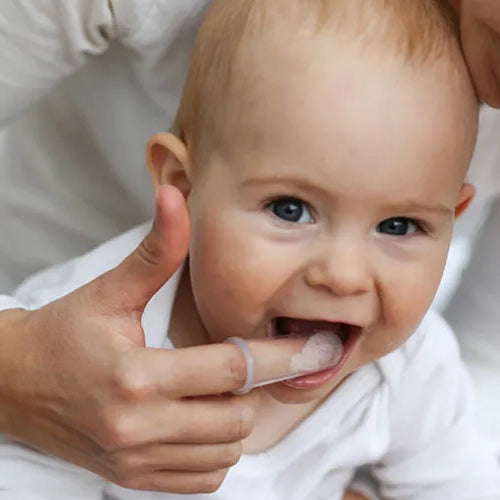
As soon as the first tooth erupts, it’s time to start brushing. Ideally, opt for a super-gentle baby toothbrush. Babies don’t like hard bristles as they irritate or even hurt the sensitive tissue on the mouth. Apply a rice grain-sized amount of kids toothpaste with an age-appropriated fluoride level on the brush head–preferably on our super-gentle baby toothbrush and get started. Now brush with small circles and clean the tiny teeth thoroughly and with care.

Brushing with children
From 6 years of age, children can change to a kids toothbrush. The brush head is a tad bigger, and it has more bristles; the toothpaste contains more fluoride and also comes in different flavours. Ideally, a child brushes three times a day for two minutes each time. It is best if kids brush their teeth in the morning, at lunchtime, and in the evening straight before hitting the bed. As young children just scrub their teeth and their dexterity does not yet allow them to perform precise brushing techniques, parents should assist and supervise the brushing—preferably until the age of 10. The easiest way to get children to regularly brush their teeth is by turning brushing time into a fun activity. For more tips, see FAQ: How do I get my child to enjoy brushing?

Which toothpaste to use for babies and kids?

Toothpastes for adults are not appropriate for babies and toddlers. The little ones might refuse to open their mouth and to cooperate as they dislike the strong mint or menthol taste.

Therefore, valuable and beneficial ingredients are crucial for a children’s oral health and development of good brushing habits. A baby and children’s toothpaste should be well-balanced, fruity, mild, and definitely free of SLS, microplastic, triclosan, and other naughty stuff.

Why fluoride?
Thanks to improved oral hygiene, healthier eating habits, and the widespread use of fluoride in toothpastes, tooth decay in children has decreased noticeably in recent years. Fluoride is an important mineral that hardens the tooth enamel making it more resistant to acid, thus preventing tooth decay and cavities. It also helps in remineralizing weakened enamel.

The following dosage for fluoride-containing toothpastes for children are recommended by the EAPD, the European Academy for Paediatric Dentistry:

Babies, from the first tooth to 2 years of age: brush twice a day with a rice-grain sized amount of children’s toothpaste (1.000ppm fluoride)

Toddlers from age 2 to 6 years: brush 3 times a day with a pea-sized amount of children's toothpaste (1.000ppm fluoride)

Children 6 years and older: brush three times a day with a pea-sized amount of toothpaste for adolescents (1.500ppm fluoride)